


 Account


Review: "Star Wars: The Book of Boba Fett #5"
Marvel’s The Book of Boba Fett #5 is a good Mandalorian story in the wrong place
When “Return of the Mandalorian” first aired, I had two very different reactions to it. As an episode of “The Mandalorian,” I thought it would have been excellent, easily a 4.5/5. As an episode of “The Book of Boba Fett,” however, it was a 2/5 at best. The action, character development, and return of Din Djarin were all good, but the decision to abandon Boba’s story for an entire episode, just as his conflict with the Pykes was building, was one of the most frustrating storytelling choices in the series.
Marvel’s “The Book of Boba Fett” #5 inherits both the strengths and weaknesses of that decision.
Rodney Barnes returns as writer, alongside artist Will Sliney, colorist Rachelle Rosenberg, and letterer VC’s Joe Caramagna. Rickie Yagawa and Tamra Bonvillain provide the main cover. Adapting “Return of the Mandalorian,” the issue delivers some of the strongest action and artwork in the series so far, but leaves me with much the same frustration I had watching the show.
Two sides of belonging
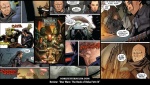
Din’s opening bounty hunt reminds me of what I have always enjoyed about Boba Fett. He enters a room full of dangerous people, says relatively little, and makes it clear that he is the most dangerous person there. His struggle to control the Darksaber, however, reveals a different kind of vulnerability.

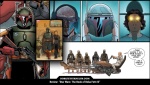
That becomes more interesting when he reunites with the Armorer and Paz Vizsla. Din has spent his life following a strict Mandalorian creed, yet after admitting that he removed his helmet, he is declared an apostate and expelled from the only community he has known.
There is an interesting contradiction here. The Armorer speaks of loyalty and solidarity as central to the Mandalorian way, yet Din is cast out for breaking a rule in order to show his face to Grogu, someone he considers family. His commitment to the people he cares about has grown stronger, even as his standing within his own tribe has been taken away.
That creates an intriguing parallel with Boba Fett’s story.
Boba has spent much of his life alone, and is now trying to build a community around himself. Din, who has defined himself through membership in a community, is suddenly being forced to live without it. Boba found acceptance among the Tuskens through his actions, while Din loses his place among the Mandalorians despite everything he has done for them.
The contrast raises a question I find particularly interesting: is belonging defined by adherence to a set of rules, or by the loyalty and responsibility we demonstrate toward one another?
It also makes Din’s eventual decision to help Boba more meaningful. He may have lost his official standing among the Mandalorians, but that has not diminished his willingness to stand beside someone he considers a friend.
I appreciate this thematic connection between the two characters. I just wish the television series had found a way to establish it without leaving Boba’s story behind for so long.
Some of the strongest artwork yet
Visually, this issue is one of my favorites so far. In fact, it has more of the feel of a classic Dark Horse “Star Wars” comic than any previous issue in this adaptation, particularly the cover by Yagawa and Bonvillain. The close-quarters confrontation, dramatic lighting, and stylized action recall some of the energy that made those earlier comics so distinctive.
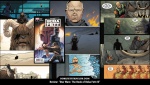
Sliney delivers similarly strong work throughout. The opening fight is fast and brutal, with the Darksaber cutting brilliant arcs through the cold, industrial surroundings of Glavis Ringworld. The later confrontation with Paz Vizsla makes good use of panel composition to emphasize the physical struggle, while Rosenberg’s colors help distinguish the sterile environments of the ringworld from the warmer tones of Tatooine.
Caramagna’s lettering adds energy to the fighting, particularly the metallic impacts and the distinctive sounds of the Darksaber. The action feels like comics rather than a series of television frames, and that is something I continue to appreciate about this adaptation.

The extended rebuilding of Din’s new N-1 starfighter is enjoyable as well, particularly for anyone who appreciates the mechanical side of “Star Wars.” Peli Motto remains entertaining, and the eventual flight test gives Sliney plenty of opportunities to show off the little fighter’s speed and maneuverability.
But this is also where the pacing starts to work against the issue. We spend a substantial amount of time assembling, modifying, and testing the N-1, just as we did in the television episode. As a chapter of “The Mandalorian,” I enjoyed spending that time with Din and his new ship. As part of a seven-issue adaptation of “The Book of Boba Fett,” it feels like time that could have been spent advancing Boba’s story.
There is also a small missed opportunity in the original television episode that has bothered me since it first aired.
Close-ups of the N-1 in the show reveal markings along the canopy rail, written in what appears to be Naboo script. I’ve wondered whether those might have been the original pilot’s markings, much like the names painted on real-world fighter aircraft. I even hoped they might match the N-1 that young Anakin Skywalker flew during the Battle of Naboo in “The Phantom Menace.”
A comparison of screen captures from the two productions clearly shows that the markings are different. But imagine what a connection like that could have added. A small detail could have given this old fighter a history beyond its recognizable design. Someone flew it long before Din Djarin. Who were they, and what happened to them?
This was an opportunity for the television series, not a shortcoming of the comic. Barnes and Sliney have faithfully reproduced what was shown on screen, and I wouldn’t expect them to rewrite the ship’s history. It is simply an example of how a small visual detail might have added another layer to a familiar part of the “Star Wars” universe.
A friend, not another bounty
The connection back to Boba finally arrives on the last page, when Fennec Shand approaches Din about helping with the coming conflict against the Pykes. Din initially assumes she is offering him a bounty, but when Fennec explains that Boba needs his help, he agrees without asking for payment. It is a brief exchange that brings Din’s story back into Boba’s orbit and gives the issue a fitting ending.

“The Book of Boba Fett” #5 is an entertaining, excellent-looking comic. The action is strong, the Dark Horse-era visual character is particularly welcome, and Din’s struggle with his Mandalorian identity gives the story some real substance. But the adaptation also faithfully reproduces what I consider the television series’ most awkward narrative detour, spending an entire chapter away from the character whose name is on the cover.
The artwork and execution elevate the material, but they cannot entirely overcome that structural problem.
What stays with me is the final exchange with Fennec. Din has lost his place within the Mandalorian covert, but he hasn’t lost his understanding of loyalty. Boba is trying to build something that will outlast the next paycheck, and here is someone willing to help him simply because he is a friend.
It is a meaningful connection between their stories, and one I appreciate more now than when the show first aired. I still wish the television series had found a way to make that connection without stepping away from Boba for an entire episode. The comic remains faithful to that decision, delivering an excellent Mandalorian story that still feels out of place in “The Book of Boba Fett.”
Rating

About the Author, Joe Carlson
BFFC Member #5936




Comments