


 Account
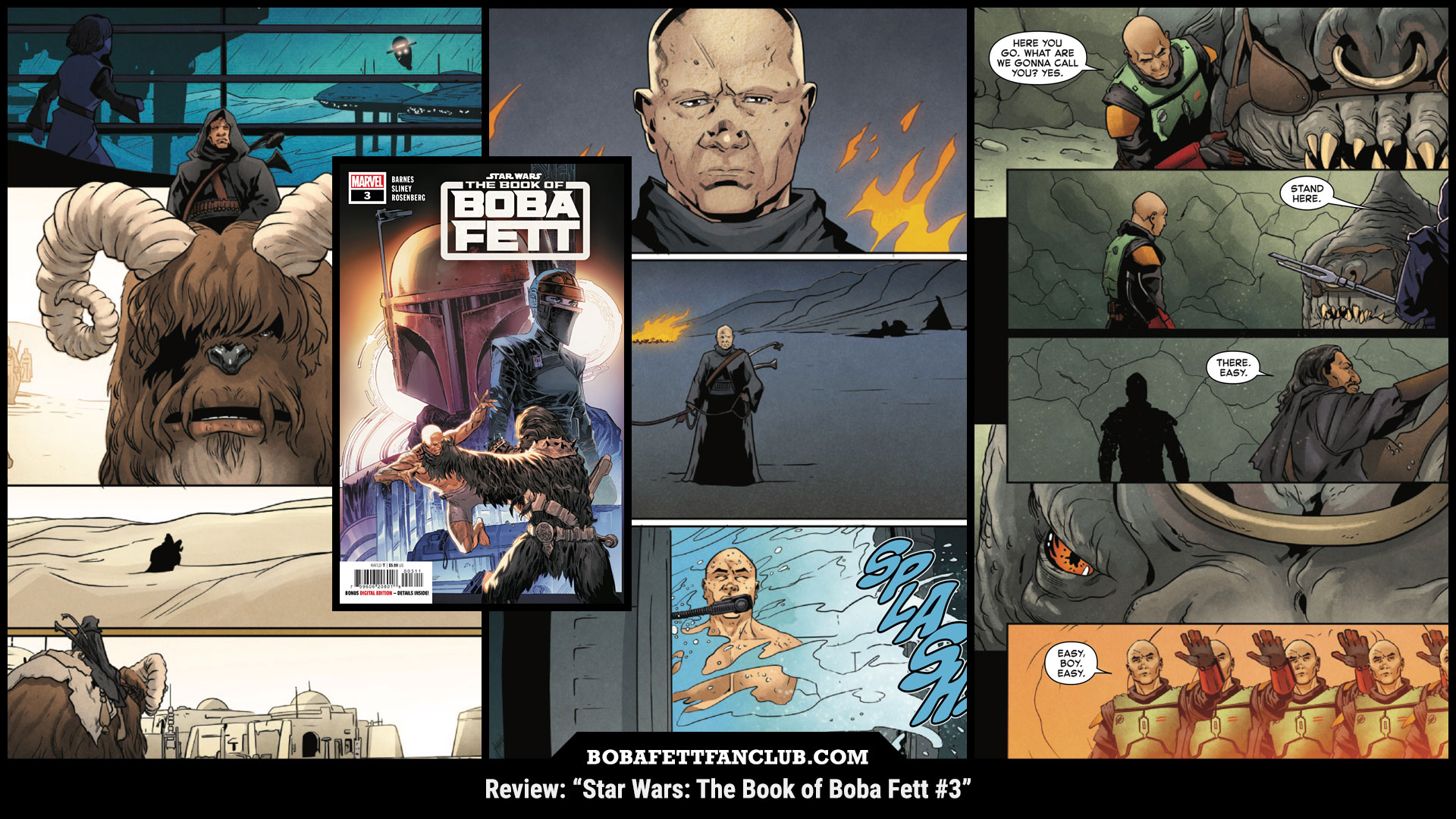
Review: "Star Wars: The Book of Boba Fett #3"
Marvel’s The Book of Boba Fett #3 gives Boba’s loss the space it needs
In my review of The Book of Boba Fett #2, I wanted a little less of the train fight and a little more dwell time with Boba’s acceptance into the Tusken tribe. Issue #3 gives the loss of that community the space it deserves and lets the reader linger there. When Boba returns to find the camp destroyed, the comic stops and lets us share the experience with him. For me, it is the strongest sequence in the issue.
Rodney Barnes returns as writer, alongside artist Will Sliney, colorist Rachelle Rosenberg and letterer VC’s Joe Caramagna. Ken Lashley and Romulo Fajardo Jr. provide the main cover. Adapting “The Streets of Mos Espa,” the issue continues the scene-by-scene approach of the previous two, but I found more to appreciate in how it handles the familiar material.

Letting the silence do the work
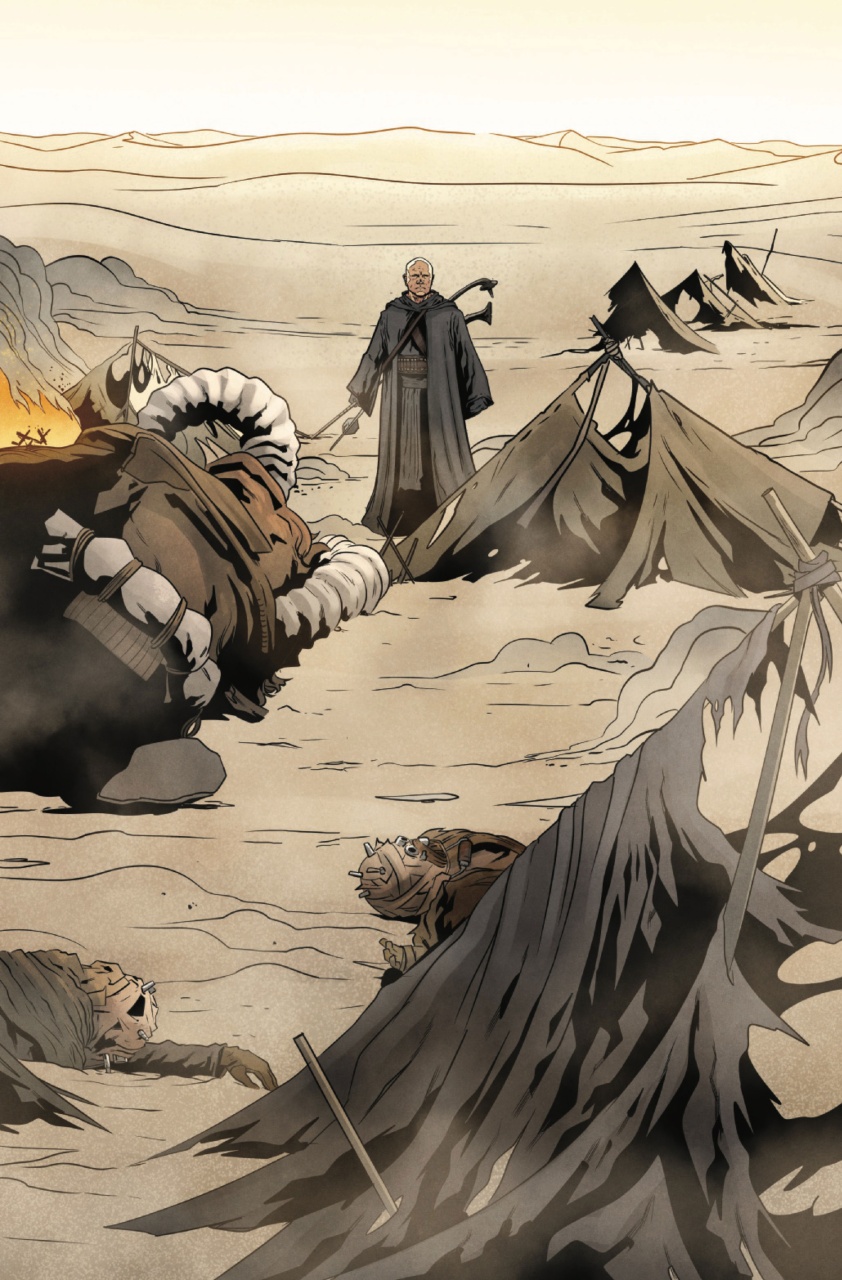
Sliney gives the ruined camp a full page. Boba stands among the collapsed tents, bodies, and remains of the place where he had become part of something. The landscape takes up most of the image, making him look small and alone. Rosenberg’s pale desert colors and the dark, torn fabric give the scene a bleakness that needs no dialogue or captions.
I like the decision to use a full-page image here. There is no fight to win and nobody left for him to protect. The page makes us spend time with that before the story moves on.
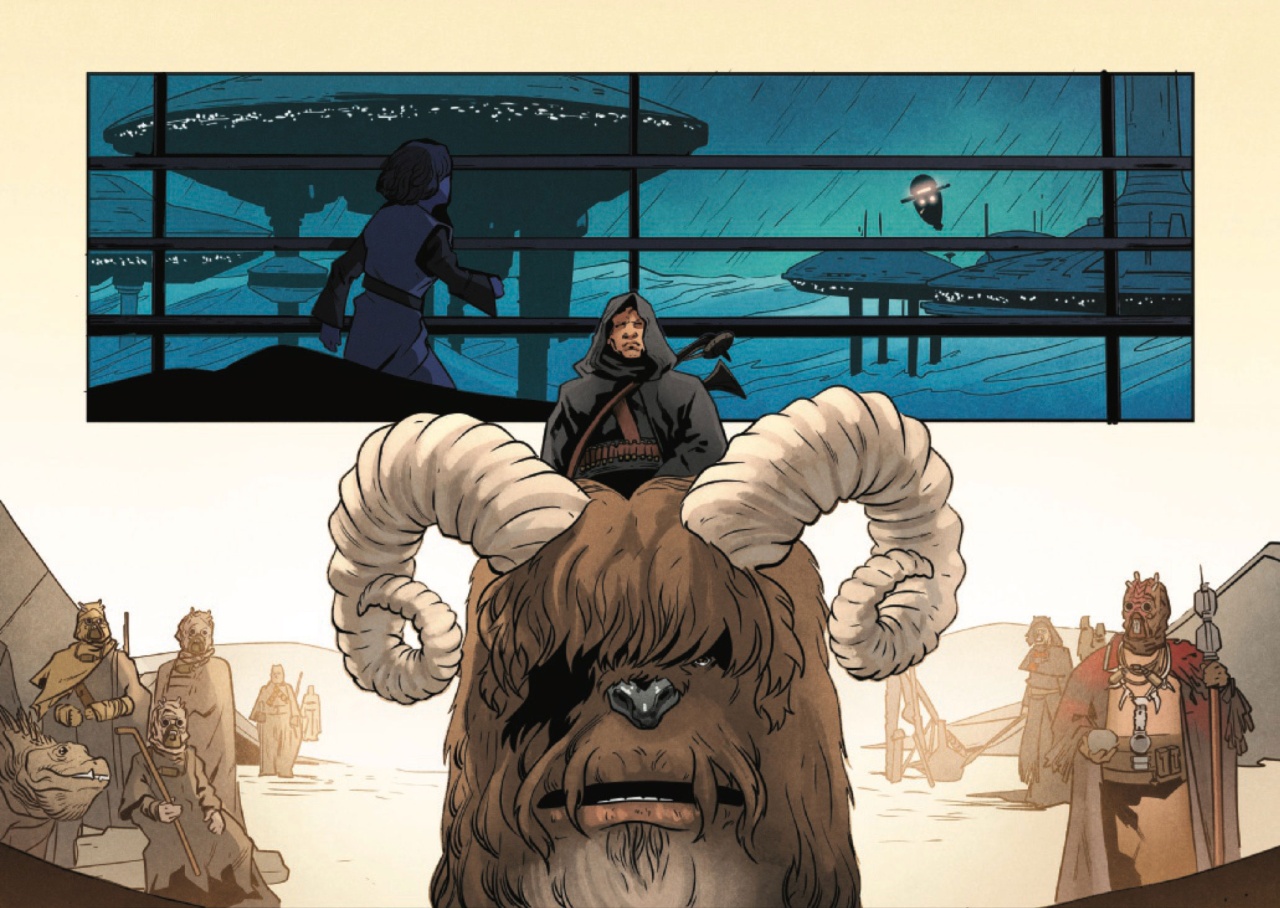
The funeral that follows is equally restrained. Silhouettes and close views of Boba preparing the pyre carry the sequence, including him placing a child’s staff into the fire. Having just watched him make his own gaffi stick and join the ceremony in the previous issue, I found that gesture particularly affecting. These weapons have come to mean something more personal than simply what they can do in a fight.
It also brought me back to the image of young Boba holding Jango’s helmet in Attack of the Clones. Losing his father helped set the course of his life. Now he is an adult mourning another family, holding something that belonged to a child he could not protect.
This is the kind of time with Boba I was looking for in earlier issues. We don’t need captions telling us what he feels; his actions and the silence around him give us enough to sit with.
What he does with what he learned
For me, Boba’s decision to recruit the young thieves in Mos Espa becomes more meaningful with those losses in mind. He has lost people who mattered to him at very different points in his life, but he is still willing to build a community. For a character I have always associated with needing nobody, that willingness to risk belonging again is a significant change.
The water merchant wants the thieves punished. Boba offers them work instead, and those recruits later help defend him against Krrsantan. His decision has a practical payoff as well as an emotional one: he gains people willing to stand beside him by giving them a place. That makes his approach to leadership feel like something he is putting into practice, rather than just a philosophy he talks about.
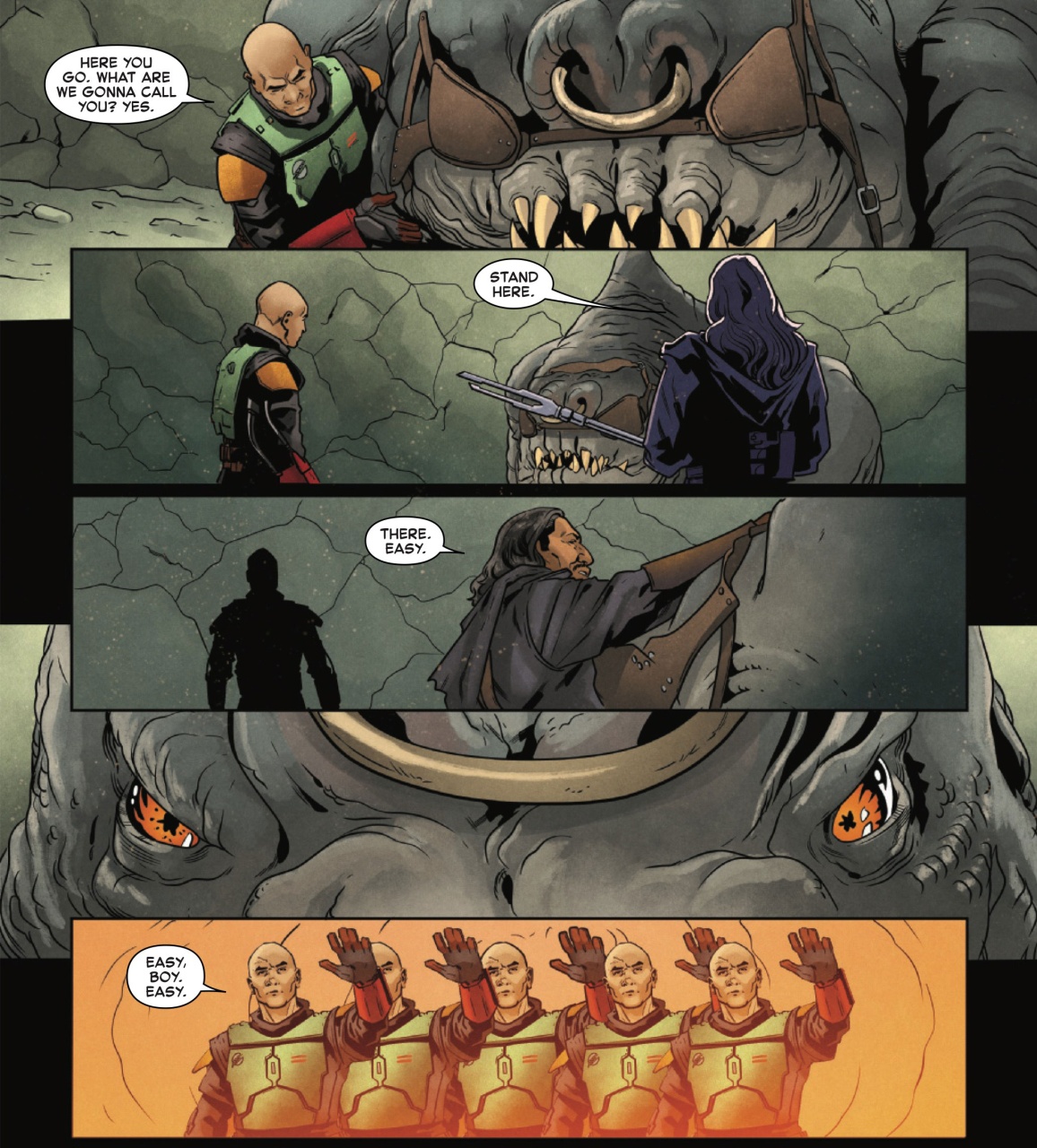
The rancor encounter adds something to that idea. Boba initially thinks of the animal as something bred for fighting, then learns that it has feelings, forms attachments, and needs care. For someone whose own value has so often been measured by what he can do in a fight, that exchange interests me. He still wants to ride the enormous, dangerous creature. Learning to care for it has not changed his appreciation for what it can do.
The action still has its place
I like how differently Sliney uses the page when Krrsantan attacks. The full-page image of the Wookiee lifting Boba crowds the frame with bodies and puts the room at an angle. Compared with the distant view of Boba in the ruined camp, it feels immediate and violent. Both images make him vulnerable, but the effect is very different.
Caramagna’s oversized roar breaks the quiet of the preceding funeral, while Rosenberg’s cold palace blues separate the attack from the desert and firelight. The shift in mood is abrupt, and it works.
There is also a smaller piece of framing I particularly like during the rancor’s introduction. A close view of its newly uncovered eyes leads into an orange-tinted strip showing repeated images of Boba reaching toward it. I read that as the creature trying to focus on him. It briefly puts us on the other side of the encounter, making this feel like a meeting rather than Boba acquiring another weapon. This is the unique retelling I’ve been looking for with this series.
The speeder chase, the most awkward and cringey sequence of the show, moves briskly and works visually here. Long horizontal panels, angled compositions and large sound effects carry the pursuit through Mos Espa. The brightly colored bikes stand out against the sandstone, and the action is easy to follow. It gives the issue another burst of energy without crowding out the quieter material that stayed with me.
The Book of Boba Fett #3 is still a faithful retelling, but it gives me a stronger reason to revisit the episode than the previous issues did. The action works, and the quieter scenes give Boba’s choices more weight. I still have reservations about how the show handled his transformation, but here I spent less time questioning it and more time understanding it. For me, that makes this the most satisfying issue of the adaptation so far.
Rating

About the Author, Joe Carlson
BFFC Member #5936





Comments