


 Account
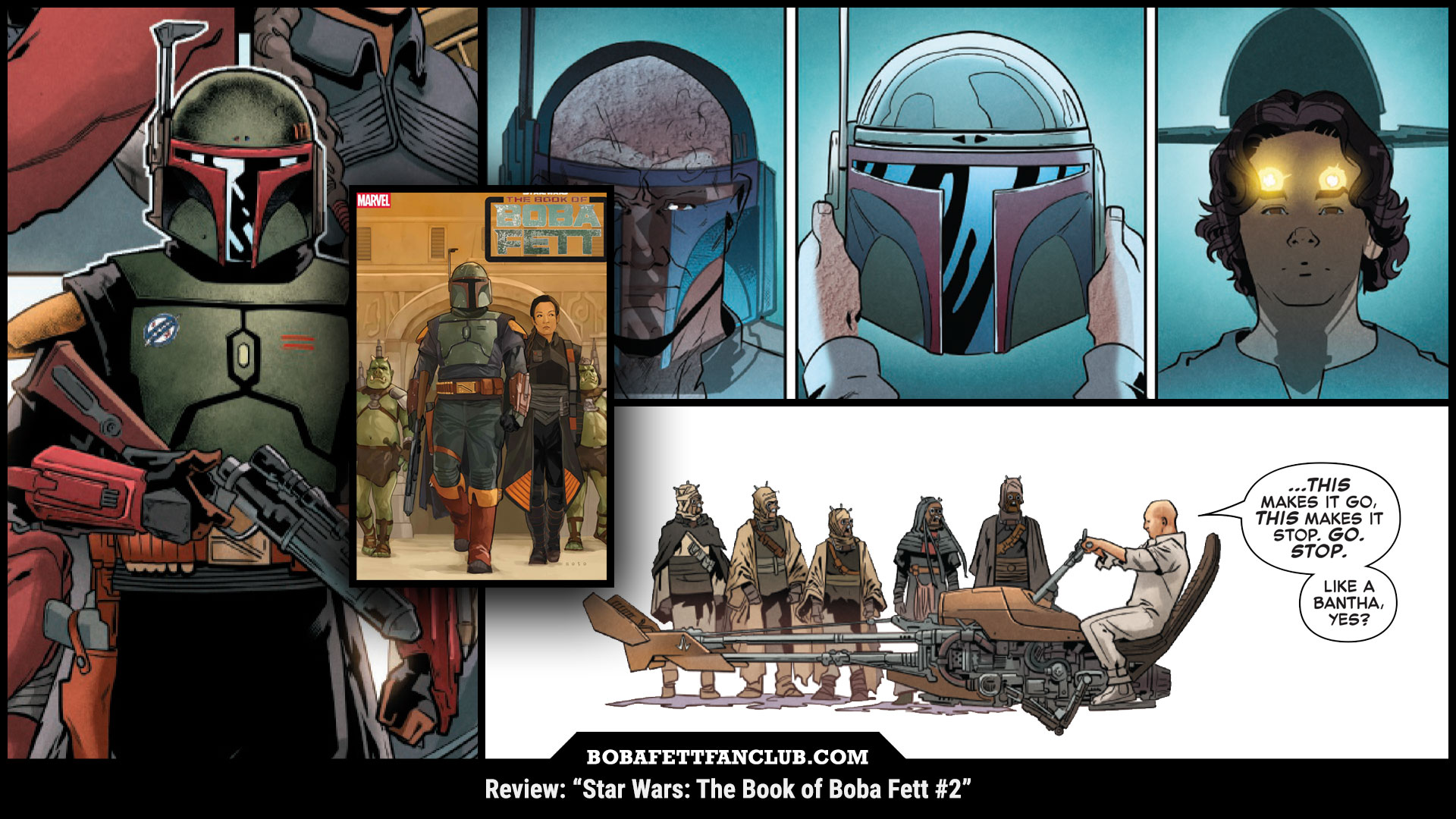
Review: "Star Wars: The Book of Boba Fett #2"
Marvel’s The Book of Boba Fett #2 gets the action right. I wanted more of what comes after.
In my review of The Book of Boba Fett #1, I hoped Marvel might find some room between the television series’ familiar scenes. Issue #2 continues much as the first began: a scene-by-scene retelling with strong artwork and little additional perspective. This time, though, it left me thinking less about adding scenes and more about choosing which existing moments deserve space. Even when an adaptation keeps the same events, does it have to give them the same emphasis?
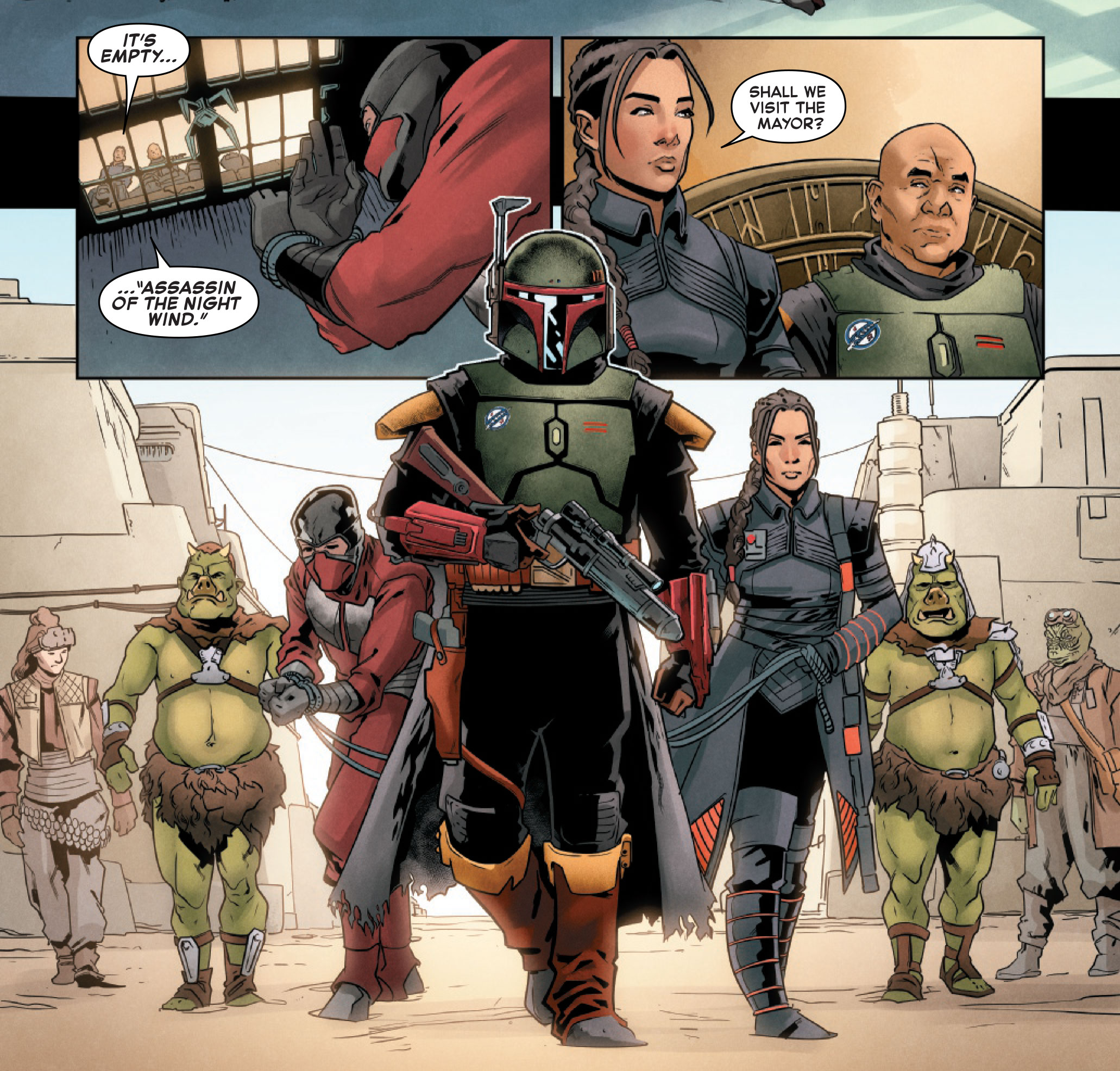
Rodney Barnes returns as writer, alongside artist Will Sliney, colorist Rachelle Rosenberg and letterer VC’s Joe Caramagna. Phil Noto provides the main cover. Adapting “The Tribes of Tatooine,” the issue gets into the Tusken material that has helped me appreciate what the television series was trying to do with Boba, even where its execution disappointed me.
Still dangerous, just working for someone different
What interests me here is not Boba becoming a softer version of himself. It is the exchange between him and the Tuskens. He teaches them to operate the speeders and prepares them to attack the Pyke train that has been firing on the tribe, but they are also teaching him. The Tusken warrior can still put him on his back during training. Boba has something valuable to offer without automatically being the best person in the room at everything.
After Boba and the Tuskens stop the train, he confronts its crew and establishes terms for future passage through Tusken territory. He demands payment and threatens consequences for further killings, but also grants the survivors safe passage and access to water. I see an early version of the leadership he later tries to exercise in Mos Espa: force backed by negotiation and a responsibility toward people other than himself.
That is a version of Boba’s transformation I can get behind. His abilities have not disappeared. They are beginning to serve a community he is becoming part of, rather than simply another employer.
Familiar tools, used well
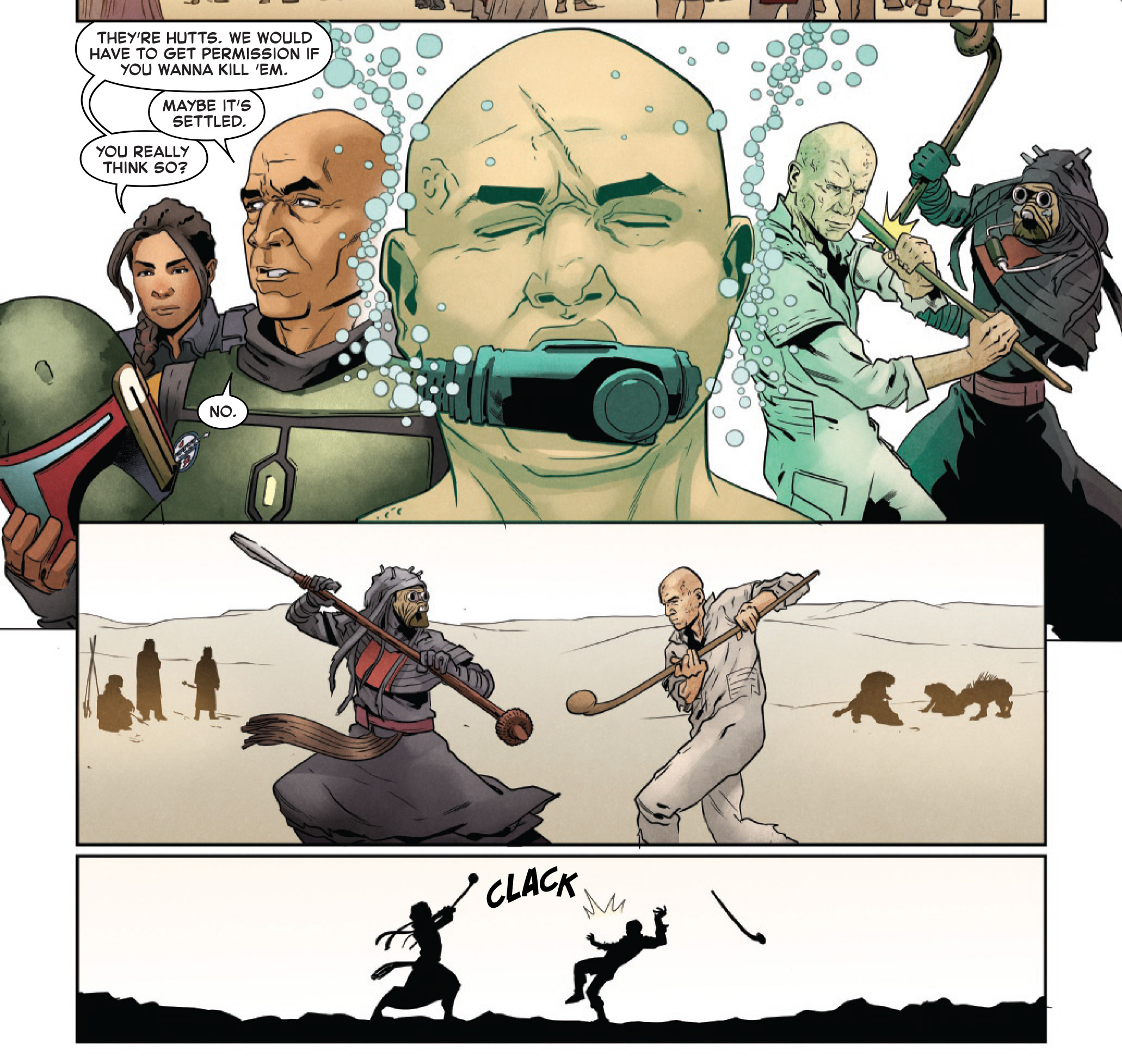
I like what Sliney is doing with the paneling. A transition through the bacta tank connects present-day Boba to his Tusken training, while repeated compositions give the train fight a clear rhythm. One sequence holds essentially the same view of a rooftop gun position across four narrow panels as the exchange of fire progresses. The consistent framing lets us follow each small change without losing our bearings in the larger fight. These are familiar techniques, but Sliney uses them well, and the page construction is one of the issue’s strengths.
Rosenberg’s colors help establish the contrast between the crowded train assault and the quieter material that follows. Dusty daylight gives way to the blue, dreamlike vision and eventually the warmth of the firelit gathering. During the making of the gaffi stick, Caramagna’s scraping and tapping effects draw our attention to Boba’s hands and the care going into his work. After the loud, flashy combat, this feels personal and contemplative, almost meditative. We are watching a man who has spent his life wielding weapons take the time to make one within a tradition he is learning. That quieter rhythm is part of what makes the scene compelling, and why I wanted the comic to stay with it longer.
Where I would have spent another page
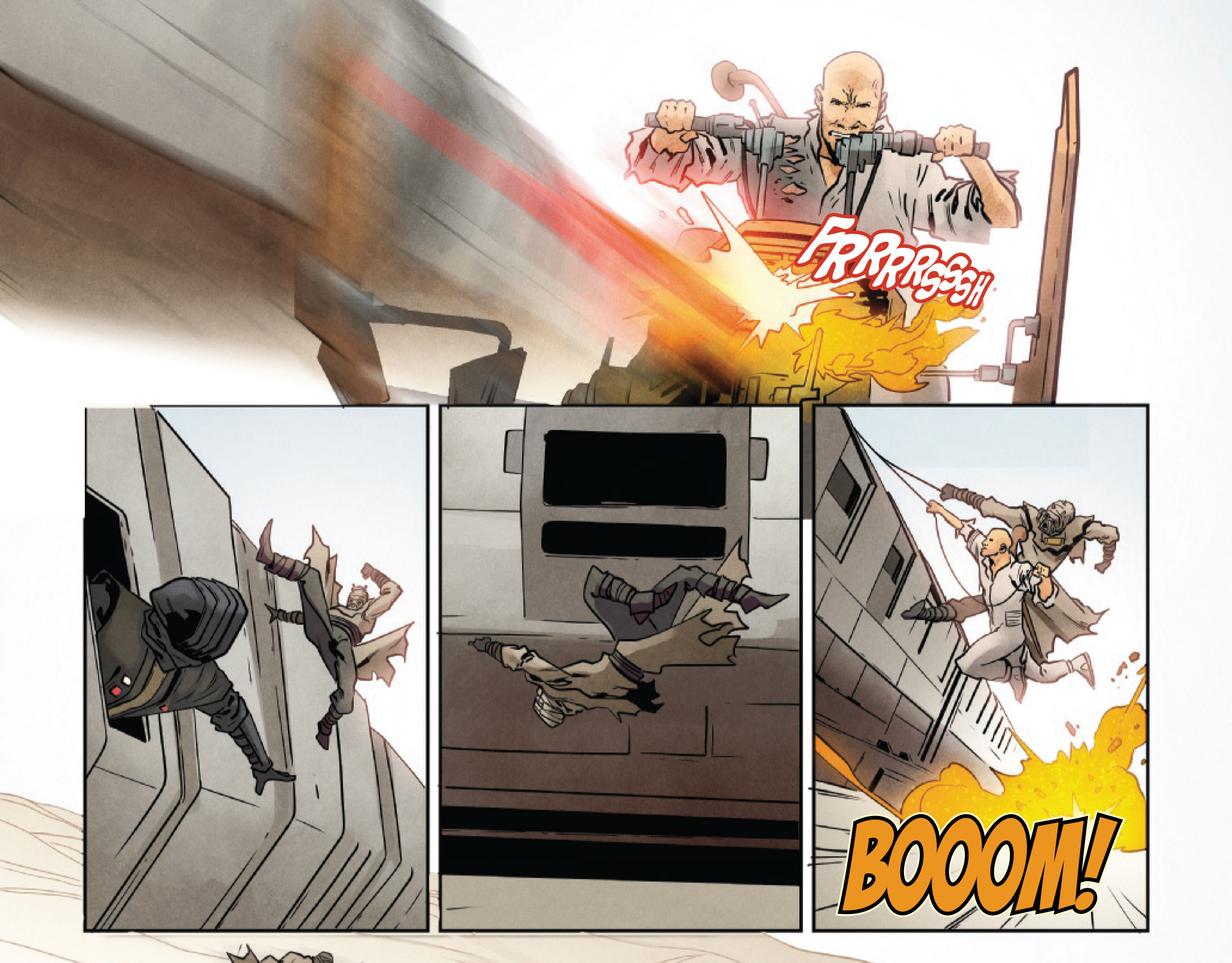
The train assault puts Boba and the Tuskens’ cooperation into practice, and Sliney gives the pursuit, boarding and fighting across the cars enough room to remain readable. I would still have traded a little of that fighting for more time with what follows. The vision, Boba’s return and his new robes lead quickly into the making of his gaffi stick and the communal ceremony. The weapon’s construction and the gathering share the final story page, leaving a significant change in his relationship with the tribe relatively little room to register.
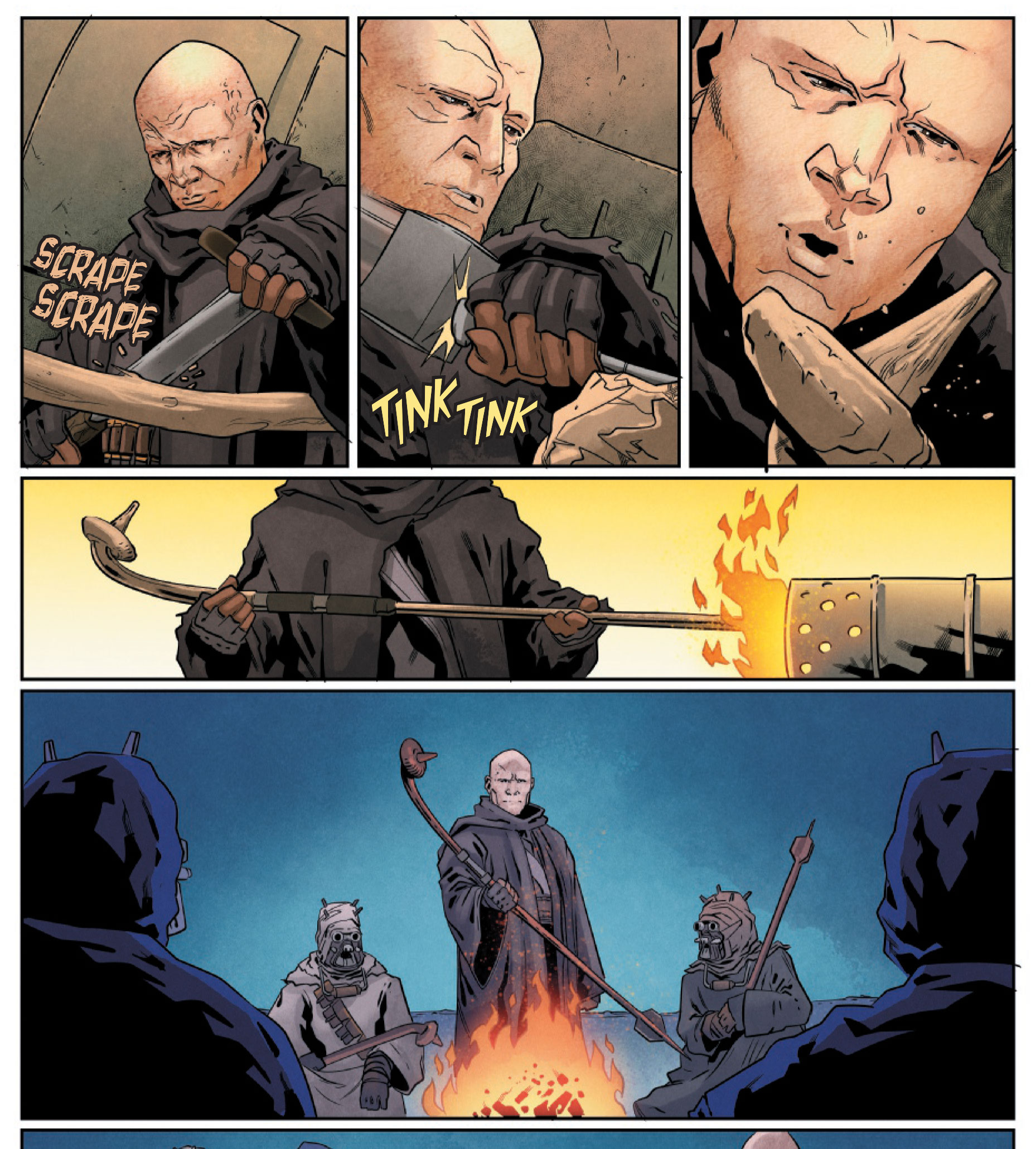
That final page moves from close views of Boba shaping the weapon to wider compositions that place him among the Tuskens. It is a clear progression from something he is doing with his hands to something he is becoming part of. This is where I wanted the comic to slow down. Giving that transition another page could have shifted the emphasis without adding a single new event.
The gaffi stick makes that change particularly interesting to me. This is the weapon we saw Boba put to wonderfully violent use during his return to action in The Mandalorian, smashing stormtrooper helmets and leaving very little doubt about how dangerous he still is. The weapon that marks his acceptance into a community is also part of a return that delivers the formidable Boba I wanted to see.
Becoming part of something did not require him to stop being Boba Fett.
The Book of Boba Fett #2 is another well-drawn adaptation that should satisfy readers looking to revisit the television episode. For me, the train fight works; the balance is what I would change. Boba’s growing connection to the Tuskens gives this chapter its weight, and a little more space for that relationship would have made the ending land harder. Two issues in, I am less interested in whether the comic will add something new than whether it will find a way to make something familiar mean more.
Rating

About the Author, Joe Carlson
BFFC Member #5936







Comments